Our Co-Occurring Disorders Worksheets
Our Co-Occurring Disorders Worksheets
Downloadable PDF Worksheets for Support with Dual Diagnoses
Finding reliable co-occurring disorders worksheets is a frequent first step for anyone who believes they stand at the intersection of a mental health condition and substance abuse. It’s an exhausting cycle that requires more than just willpower (despite what others have told you!).
Learning to manage daily life when you struggle with drug or alcohol addiction, plus a mental illness, requires a specialized, integrated approach that addresses both conditions at the same time. You might also hear co-occurring disorders called “dual diagnosis,” they are interchangeable terms.
Shanti Recovery and Wellness offers comprehensive solutions in the form of online IOP services to help clients overcome substance abuse while learning to manage their mental health issues.
Keep reading to learn more and remember to download our two helpful resources to help you understand dual diagnosis disorders as well.
Dual Diagnosis Worksheets for Co-Occurring Mental Health + Substance Use Disorders’
The first step in getting help for any mental health concern is self-reflection. Research suggests that individuals who actively engage in their treatment through written exercises show a marked increase in self-awareness. Our psychoeducation sheets help explain the link between mental health symptoms and substance use.
Our dual diagnosis worksheets are structured, self-guided, and designed to help individuals with co-occurring disorders and substance use disorders understand their conditions and create a recovery plan. In fact, using therapeutic worksheets as session prompts can help clients reflect on their recovery and share progress during therapy appointments, enhancing the therapeutic process.
Our Informal Co-Occurring Disorders Checklist: A Downloadable Resource
Our Co-Occurring Disorders Worksheet is a powerful tool. The checklist format helps you identify moments when your mental state and substance use collide. The self-assessment covers 12 specific indicators.
For instance, you’ll consider if you use substances to numb racing thoughts or find that your depression worsens when sober. Completing this checklist can provide better guidance to your clinical team during your first counseling sessions.
What are the Most Common Signs of Dual Diagnosis Disorders?
Recognizing a co-occurring disorder isn’t always easy, as one condition can mask the other. For instance, someone with post-traumatic stress disorder (PTSD) might use alcohol to calm their hypervigilance.
Research shows that when people ignore the warning signs, the relationships in a person’s life suffer, which creates a new problem: a diminished support system.
Three common signs of dual diagnosis disorders include:
- Sudden, intense mood swings unrelated to immediate events.
- Avoiding responsibilities to focus on obtaining substances.
- A feeling of being “on edge” whenever you are not using.
15 Self-Affirmations for People with a Mental Illness: Additional Resources
Our second co-occurring disorder worksheet is a collection of 15 “I am” affirmations, which address the burden of a mental illness with addiction. These are designed to be used daily in response to the negative self-talk of mental health conditions like bipolar disorder or schizophrenia.
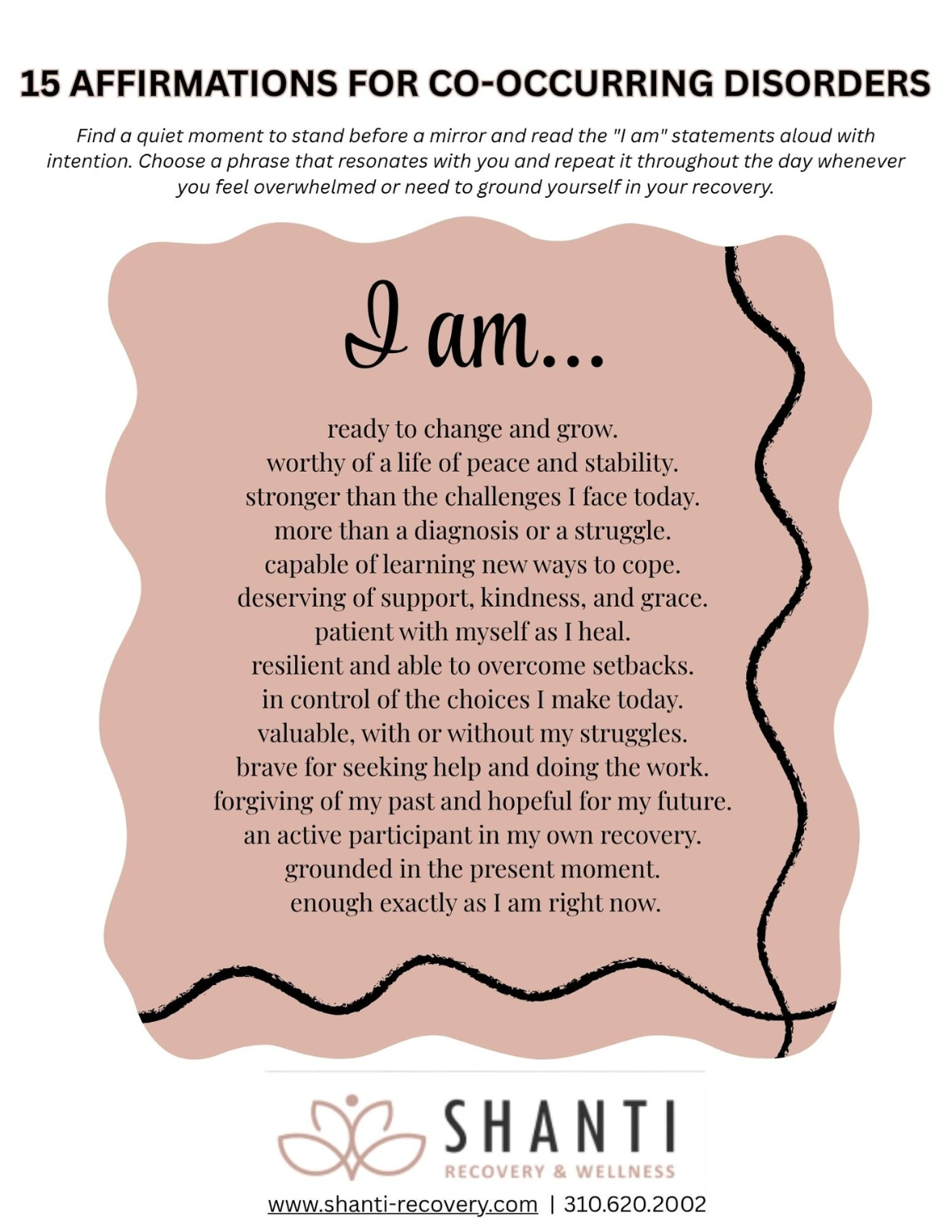
How Affirmations Help During Active Recovery and as Relapse Prevention
In recovery and relapse prevention, affirmations serve as a circuit breaker. When negative thoughts start to surface, the statements interrupt the thoughts by reminding the person of their own worth.
In psychoeducation programs, clients learn that repeating positive truths can actually rewire the brain’s stress response. That makes it easier to address challenging topics in therapy.
Start feeling better today with Shanti Recovery & Wellness.
Start feeling better today with Shanti Recovery & Wellness.
The Bond Between Mental Health Disorders and Substance Abuse
The links between dual diagnosis conditions can be deep and biological. Risk factors for developing co-occurring disorders include adverse childhood experiences, untreated ADHD, early drug use, and genetic predisposition, with genetics accounting for 40% to 60% of a person’s vulnerability to substance use disorders.
With dual diagnosis, the brain’s reward system is altered by the substances, making it nearly impossible to manage another condition, like depression, without professional help. At Shanti, we describe this to a psychological knot that we unravel using proven Western medicine and Eastern mindfulness practices.
Common Mental Illnesses That Overlap With Substance Use
Approximately 21.2 million adults in the United States have co-occurring disorders, according to 2024 SAMHSA data. But what are the conditions that overlap with substance abuse? Here are a few:
- Depression
- Eating disorders
- Post-traumatic stress disorder (PTSD)
- Personality disorders
- Anxiety and panic disorders
Those are the primary examples, but any mental health conditions can co-exist with substance use disorders.
SAMHSA Suggests Integrated Treatment Plans for Dual Diagnoses
The Substance Abuse and Mental Health Services Administration (SAMHSA) research shows that integrated treatment addressing both mental health and substance use disorders simultaneously leads to better outcomes than treating each condition separately.
Effective integrated treatment plans often include evidence-based practices such as Cognitive Behavioral Therapy (CBT) and holistic approaches to support recovery from both mental health and substance use disorders. Our integrated treatment team offers those evidence-based practices to help you identify and swap the negative thoughts that lead to poor mental health for postive thoughts that support your well-being.
Breaking the Cycle of Self-Medicating for Relief
Many started using substances as a response to psychological pain. For instance, a person with social anxiety may drink to feel comfortable in groups. Breaking this cycle becomes far more complicated than just topping the substance. It requires finding a new way to manage the anxiety. We help you identify those moments where the urge to self-medicate hits and help you find better ways to cope.


Developing Healthy Coping Tools for Long-term Relief
Long-term progress comes from building new skills. We teach mindfulness as a way to stay grounded in the present as you work on your wellness.
Mindfulness techniques teach individuals to observe and describe their emotions rather than being consumed by them. Some methods we use include yoga, sound bathing, and meditation. We work with each client to help them discover the most effective way to meet their recovery goals.
Find Effective Support for Co-Occurring Disorders at Shanti
Are you ready to live a better quality of life? The counselors at Shanti Wellness and Recovery help you achieve positive outcomes, equipping you with the tools you need to create the life you have always wanted.
Place a free, confidential call to our admissions team today to learn about our online IOP programs, scheduling options and support services.
Up To 100% of Rehab Costs Covered By Insurance
Up To 100% of Rehab Costs Covered By Insurance
References
- Ackerman, C. E. (2017, September 6). Writing therapy: How it works and why it helps. com. https://positivepsychology.com/writing-therapy/
- Clark, R. E. (1994). Substance abuse and family relationships of persons with severe mental illness. Psychosomatic Medicine, 56(6), 517–524. https://pubmed.ncbi.nlm.nih.gov/7864278/
- National Institute on Drug Abuse. (2018). Drugs, brains, and behavior: The science of addiction. National Institutes of Health. https://irp.nida.nih.gov/wp-content/uploads/2019/12/NIDA_DrugsBrainsAddiction_2018.pdf
- Substance Abuse and Mental Health Services Administration. (2012). SAMHSA’s working definition of recovery: 10 guiding principles of recovery. U.S. Department of Health and Human Services. https://library.samhsa.gov/sites/default/files/pep12-recdef.pdf
- Substance Abuse and Mental Health Services Administration. (2024, July 30). Release of the 2024 National Survey on Drug Use and Health: Leveraging the latest substance use and mental health data to make America healthy again. https://www.samhsa.gov/blog/release-2024-nsduh-leveraging-latest-substance-use-mental-health-data-make-america-healthy-again