If you’re exploring virtual intensive outpatient programs for substance use disorders or co-occurring mental health conditions, one of the first questions that comes up is whether your PPO insurance will help cover the cost-even if the provider is out of network. The answer is more nuanced than a simple yes or no, but for many California residents with PPO coverage, meaningful reimbursement is possible.
This guide breaks down exactly how out-of-network PPO benefits apply to virtual IOP, what you can expect to pay, and how Shanti Recovery & Wellness can help you navigate the process.
Quick Core Takeaways
- Many PPO health insurance plans do include out-of-network benefits that can partially reimburse virtual intensive outpatient program costs, but insurance coverage for virtual IOP varies significantly by plan.
- Coverage almost always depends on medical necessity, prior authorization, and whether your specific plan recognizes virtual IOP as a covered level of care.
- Out-of-network care typically means higher deductibles and coinsurance rates. Clients may need to pay upfront and then seek out of network reimbursement using a superbill provided by the treatment provider.
- HMO plans generally do not cover virtual IOP services from out-of-network providers, so confirming your plan type matters before you begin.
- Shanti Recovery & Wellness offers complimentary insurance verification for California residents, helping you understand your expected out of pocket costs and coverage for virtual IOP before you start treatment.
Can You Use Out-of-Network PPO Insurance for a Virtual IOP in California?

Yes – many PPO insurance plans allow you to use out-of-network benefits for virtual intensive outpatient treatment, but coverage is not guaranteed and is highly plan-specific. Most major PPO plans cover virtual IOP services in California, though the amount reimbursed and the process for accessing those benefits differ from one plan to the next.
When we say “out of network,” it means Shanti Recovery & Wellness does not currently have a contracted rate with your insurance company. Instead, your plan pays according to its out-of-network benefit structure, which typically involves higher cost sharing on your part. Out-of-network PPO plans provide partial coverage for virtual intensive outpatient programs, and for California adults dealing with substance use disorders or co occurring disorders, PPOs like Anthem, Blue Shield, Aetna, Cigna, Health Net, and UnitedHealthcare often reimburse a percentage of virtual IOP charges after the out-of-network deductible is met.
Shanti Recovery & Wellness is currently in the process of credentialing with multiple major insurance providers, which means in-network status is on the way. In the meantime, we can work with your PPO out-of-network benefits now, providing superbills and claims support so you can seek reimbursement from your insurance company directly.
If you want a fast answer for your specific plan, we recommend reaching out for a confidential insurance verification so you can see realistic estimates of what your insurer will pay versus your own financial responsibility before enrolling.
Understanding Virtual IOP and Why It’s Billed Differently Than Weekly Therapy
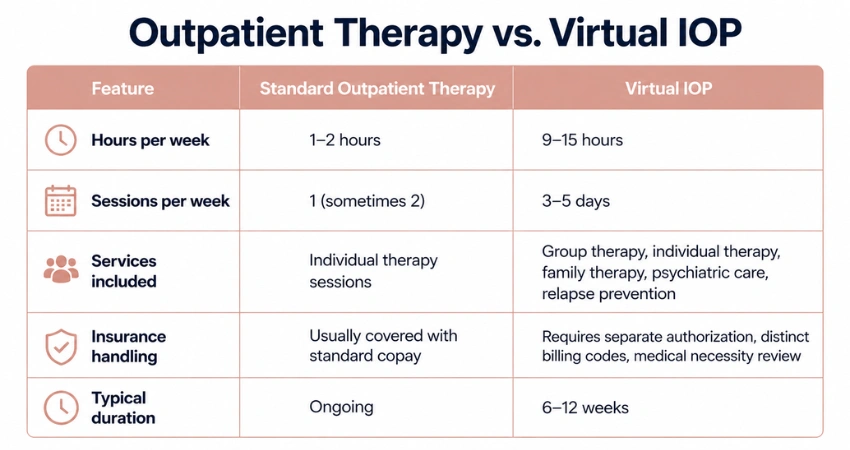
An intensive outpatient program IOP is a structured level of behavioral health treatment more intensive than standard outpatient therapy. Virtual IOPs typically involve 9–15 hours of treatment weekly, with participants engaging in therapy sessions three to five days a week. The programming usually includes individual and group therapy, family therapy sessions when clinically appropriate, psychiatric evaluations, and relapse prevention work.
Shanti’s virtual IOP in California is delivered fully online via secure telehealth platforms for therapy delivery, but clinically it matches an in-person IOP level of care for substance abuse, addiction treatment, and dual diagnosis. Telehealth services must be covered at the same rate as in-person services under California law, reinforcing that virtual delivery does not diminish the clinical standard.
Because virtual IOP is more intensive than weekly scheduled therapy sessions, insurers treat it as a distinct level of care with its own billing codes, utilization review process, and medical necessity standards. This is why prior authorization and detailed clinical documentation are almost always required-especially for out of network services.
Here’s a quick comparison so you can see how intensive outpatient programs differ from standard outpatient therapy:
|
Feature |
Standard Outpatient Therapy |
Virtual IOP |
|
Hours per week |
1–2 hours |
9–15 hours |
|
Sessions per week |
1 (sometimes 2) |
3–5 days |
|
Services included |
Individual therapy sessions |
Group therapy, individual therapy, family therapy, psychiatric care, relapse prevention |
|
Insurance handling |
Usually covered with standard copay |
Requires separate authorization, distinct billing codes, medical necessity review |
|
Typical duration |
Ongoing |
6–12 weeks |
This higher level of structure and clinical intensity is part of what makes virtual IOP effective for people who need more support than weekly visits can provide-but it also means the insurance process requires more documentation and planning.
How PPO Out-of-Network Benefits Work for Virtual IOP

PPO health plans are more flexible than HMO or EPO plans because they usually include both in-network and out-of-network benefits for behavioral health treatment, including intensive outpatient programs. If your plan is a true PPO, you almost certainly have some level of out of network coverage-though the financial terms will be less favorable than in network.
Here are the common PPO cost components to understand:
- Separate deductibles: Most insurance plans have one deductible for in network providers and a higher one for out of network providers. Out-of-network deductibles are often double or more the in-network amount.
- Coinsurance rates: After meeting the deductible, your plan shares costs via coinsurance. In-network, you might pay 20% while the insurer covers 80%. For out of network services, higher deductibles and coinsurance rates typically apply-often 40–50% on your side.
- Allowed amount (UCR): Insurance companies commonly reimburse out-of-network care based on an allowed amount rather than actual charges. This “usual, customary, and reasonable” figure is set by your insurer and may be lower than what the treatment provider charges.
- Balance billing: If Shanti’s rate is higher than the allowed amount, you are responsible for the difference-this is called balance billing.
The Mental Health Parity Act requires equal coverage for mental health services compared to medical and surgical benefits across most group health plans. This means your plan cannot impose stricter visit limits or financial requirements on mental health treatment than it does on comparable medical care. Using an out-of-network provider often results in higher personal costs and administrative processes, but the parity protections still apply to how the plan structures its behavioral health benefits.
Out-of-network benefits typically require the patient to first meet their specific out-of-network deductible before the plan begins sharing costs.
A concrete example: Suppose your virtual IOP program costs $3,000 over 8 weeks. Your PPO has a $2,000 out-of-network deductible (not yet met) and 60/40 coinsurance (plan pays 60% of its allowed amount). If your insurer’s allowed amount for the program is $2,400:
- You pay the first $2,000 (deductible).
- The remaining $400 of allowed charges: insurer pays 60% ($240), you pay 40% ($160).
- You also owe the $600 difference between Shanti’s charge ($3,000) and the allowed amount ($2,400).
- Your total out-of-pocket: approximately $2,760. The insurer pays $240.
This example is simplified-your actual numbers depend entirely on your specific plan. That’s why verifying insurance benefits before starting is critical.
Medical Necessity, Prior Authorization, and Documentation for Out-of-Network Virtual IOP
Out of network coverage for an intensive outpatient program almost always hinges on medical necessity and the plan’s pre-certification rules. Insurance companies require treatment to be medically necessary for coverage, and many insurance plans require prior authorization for virtual IOP services before they will agree to reimburse any portion of the cost. Pre-authorization is often required for insurance coverage of online IOPs regardless of network status.
In practical terms, medical necessity for substance use disorders and co-occurring mental health conditions means that your symptoms significantly impair daily functioning, you have a history of relapse, you have not responded adequately to lower levels of care like standard outpatient therapy, or your clinical presentation requires the intensity and structure of an IOP.
California law prohibits insurers from imposing stricter limits on mental health benefits than on comparable medical benefits, and California’s regulations require that outpatient services meet medical necessity to protect life, prevent significant illness, or alleviate severe symptoms.
Many PPOs require prior authorization for IOP-even when using out of network benefits. If this step is skipped, your insurance company may deny or only partially reimburse claims after the fact.
Shanti’s clinical and admissions teams can help gather the assessments, diagnoses, and treatment plan documentation needed to support medical necessity reviews and authorization requests. Typical documents insurers may request include: a comprehensive diagnostic evaluation, an ASAM (American Society of Addiction Medicine) or similar level-of-care assessment, clearly defined treatment goals, and ongoing progress notes demonstrating continued need. Having this documentation prepared and submitted correctly is one of the most important steps in securing out of network coverage.
What You May Pay Out of Pocket for Out-of-Network Virtual IOP

Even with PPO coverage, out of pocket costs for out-of-network care are usually higher than for in-network care. Here’s what contributes to your out-of-pocket expenses when using out-of-network benefits for virtual IOP:
- Out-of-network deductible: For many California PPO policies in 2025–2026, out-of-network deductibles can range from about $1,000 to over $7,500 per person. Some clients will effectively pay most of the first several weeks themselves before any reimbursement kicks in.
- Coinsurance percentage: After the deductible is met, you still pay a share-commonly 40–50% of the allowed amount.
- Balance billing: The difference between Shanti’s fees and the insurer’s allowed amount.
- Non-covered services: Additional services may incur costs that are not fully covered under the base program, such as optional holistic add-ons that some plans do not reimburse.
- Out of pocket maximums: Many plans have separate out of pocket maximums for out-of-network care, and in some cases the federal ACA out-of-pocket cap applies only to in-network covered services.
Virtual IOPs in metropolitan areas often have higher rates associated with them, so location within California can influence what you pay. For a realistic picture, consider this breakdown of virtual IOP costs as a starting point.
Worked-through scenario: Imagine an 8-week virtual IOP billed at $500 per week ($4,000 total). Your plan has a $3,000 out-of-network deductible (partially met-$1,000 remaining) and 50/50 coinsurance on a $3,200 allowed amount.
- Weeks 1–2: You pay $1,000 to finish meeting your deductible.
- Weeks 3–8: The remaining $2,200 of allowed charges splits 50/50-insurer pays $1,100, you pay $1,100.
- Balance billing: $800 difference between $4,000 charged and $3,200 allowed.
- Total out-of-pocket: approximately $2,900. Insurer pays $1,100.
Despite higher cost sharing, some clients choose out-of-network virtual IOP because of scheduling flexibility, clinical fit-such as dual diagnosis expertise or holistic healing options-or the simple absence of any in-network virtual IOP in their area.
Out-of-network benefits can reduce costs for virtual IOP treatment compared to paying entirely out of pocket.
Shanti Recovery & Wellness: Using PPO Out-of-Network Benefits for Our Virtual IOP
Shanti Recovery & Wellness is a California-based telehealth provider offering virtual IOP for addiction recovery and co-occurring mental health conditions. Our programs combine evidence-based therapies-including Cognitive Behavioral Therapy (CBT) and Dialectical Behavior Therapy (DBT)-with holistic practices like meditation and yoga that are integrated into treatment, along with breathwork, mindfulness, and relapse prevention planning.
Shanti is in the process of becoming an in-network provider with several major insurers. Until credentialing is finalized, we can often work with PPO out of network coverage, including some plans that also cover Medi-Cal-linked PPO products for virtual care.
California Senate Bill 855 mandates mental health coverage for telehealth, and California mandates coverage for telehealth services including virtual IOP, which supports the viability of using your PPO benefits with our program.
Here’s how our insurance workflow typically looks for PPO out-of-network clients:
- Complimentary insurance verification – You share your insurance information (member ID, group number, plan type), and our admissions team checks your out of network benefits.
- Estimate of network benefits – We provide an estimate of expected out of pocket expenses based on your plan’s deductible, coinsurance, and allowed amounts.
- Discussion of payment plans – We review payment options, including payment plans and self-pay rates if needed.
- Superbill for claims submission – After sessions, you receive detailed superbills with diagnosis codes, dates of service, and IOP billing codes to submit to your insurance company directly for potential reimbursement.
Shanti’s virtual IOP commonly includes group therapy, individual therapy sessions, and when clinically indicated, family therapy and coordination with prescribers-which can be important for insurers evaluating the program’s medical necessity. Our licensed clinicians document treatment in a way that supports ongoing authorization and claims review.
Step-by-Step: How to Check If Your PPO Covers Out-of-Network Virtual IOP

Confirming network status with the provider is essential before beginning treatment. Here’s a practical guide to verifying insurance benefits, whether you call your insurer directly or let Shanti handle it.
What to gather before calling:
- Your insurance card (front and back)
- Plan type (PPO, EPO, HMO, or POS)
- Whether you’ve met any of your 2026 deductible so far
- Whether you’ve used any behavioral health treatment services this year
Questions to ask our team at Shanti’s or your insurance company directly:
- Do I have out of network benefits for virtual intensive outpatient programs?
- What is my out-of-network deductible, and how much have I met this year?
- What coinsurance rate applies for out of network behavioral health treatment?
- Is prior authorization required for intensive outpatient treatment delivered via telehealth?
- What CPT or billing codes does the plan recognize for IOP-level telehealth services?
- Does my plan cover mental health services and substance abuse treatment at the same level as medical/surgical benefits?
Note that HMO plans generally do not cover virtual IOP services from out-of-network providers. If your plan is an HMO rather than a PPO, your options may be limited to in network providers or your county mental health plan.
Shanti’s team can perform this insurance verification on your behalf, interpret confusing terms, and then review the results with you in the context of actual virtual IOP scheduling and expected length of stay.
Important: Document the date of any calls with your insurer, the representative’s name, and any reference or confirmation numbers provided. This paper trail can be essential if reimbursement issues arise later-insurance companies process thousands of claims, and having records protects you.
When Choosing an Out-of-Network Virtual IOP Still Makes Sense
Staying in network is usually cheaper on paper, but it’s not always clinically or practically the best fit for every individual in their recovery journey. Here are common situations where out-of-network online treatment may be worth the higher personal cost:
- No local in-network IOP options: Many areas of California lack in-network virtual or in-person intensive outpatient programs, especially those specializing in mental health and substance use treatment together.
- Schedule constraints: You need evening-only sessions, or your work and family responsibilities make a fixed daytime program impossible. Virtual IOPs allow clients to maintain daily responsibilities during treatment.
- Clinical fit: You want a program that integrates dual diagnosis treatment with holistic supports-something not offered by every in-network provider.
- Prior negative experiences: You’ve tried in-network programs that weren’t effective, and a different clinical approach could make the difference.
Adult clients in California who work full time, care for children or aging parents, or live in rural areas of California may find a flexible, home-based virtual IOP critical for staying consistently engaged in quality care. California’s Assembly Bill 1705 strengthens mental health parity enforcement, which means the regulatory environment increasingly supports access to online mental health treatment regardless of whether the provider is in network.
When comparing costs, consider the full picture: travel expenses, time off work, childcare, and the real cost of relapse or untreated mental health challenges. Sometimes the “cheaper” in-network option becomes more expensive in practice when you factor in everything else.
Get Virtual IOP Covered Using PPO Insurance at Shanti Recovery & Wellness

While insurance verification and maximizing network benefits are important, Shanti’s core focus is supporting effective recovery from substance use disorders and co-occurring mental health conditions.
Our clinical program is designed to deliver quality care that produces real, lasting change for our clients.
Shanti’s program is designed to help clients build coping skills and transition either from higher levels of care (like medical detox or residential treatment) or as an additional support during early recovery, whether you are in sober housing or living on your own.
If you or a loved one is dealing with mental health challenges or substance abuse, reaching out today is the most important thing you can do. Call us confidentially today for information and support.
FAQs on Out-of-Network PPO Insurance and Virtual IOP
Will my PPO pay me back if I pay Shanti’s virtual IOP costs upfront?
Many PPO health insurance plans reimburse members directly for out-of-network behavioral health services once a claim is submitted and the out-of-network deductible is met. Shanti can provide a detailed superbill with diagnosis codes, dates of service, and IOP billing codes, which you can submit to your insurer for potential out of network reimbursement.
Reimbursement amounts and timelines are controlled by your insurance company, not Shanti-verifying insurance benefits before starting gives you the best estimate but cannot guarantee payment. Ask your insurer whether they reimburse members directly for virtual intensive outpatient services and what percentage of the allowed amount they typically pay.
Is virtual IOP covered the same as in-person IOP under California telehealth laws?

Under California’s telehealth parity rules (Insurance Code § 10123.855), many private insurance plans must cover telehealth for medically necessary services like intensive outpatient programs on comparable terms to in-person care. California Senate Bill 855 mandates coverage for telehealth services, and mental health parity laws reinforce these protections.
However, this does not mean every plan must automatically cover every virtual IOP-when a plan covers in-person IOP, it generally cannot deny coverage solely because services are delivered online. Plan-specific rules around network status, prior authorization, and benefit caps still apply, especially for out of network coverage. Shanti’s verification process specifically asks insurers how their telehealth and IOP rules interact for your policy year.
Can I use out-of-network PPO benefits if I also have Medi-Cal?
Coordination between a commercial PPO and Medi-Cal can be complex and depends on whether Medi-Cal is your primary or secondary coverage. In many cases, clients use their commercial PPO benefits first for virtual IOP, and Medi-Cal may cover certain remaining costs only if specific criteria are met and the provider is appropriately enrolled.
Shanti accepts Medi-Cal for some services and is actively expanding its insurance relationships, so the admissions team can review both policies and outline realistic options for you. If you have dual coverage (PPO plus Medi-Cal), contact Shanti directly rather than making assumptions-the optimal billing strategy can differ case by case.
Does using out-of-network benefits mean my insurer has access to my full therapy notes?
Insurers generally receive limited clinical information-diagnosis codes, dates of service, types of covered services, and brief medical necessity summaries-rather than full session transcripts or detailed therapy notes. Shanti complies with HIPAA and California privacy laws, sharing only what is needed for authorization and claims processing, and keeps full therapy notes confidential within the treatment team.
You can discuss any privacy concerns with Shanti’s clinicians or admissions staff before enrolling. Choosing to use health insurance always involves some sharing of health information, but this is tightly regulated and focused on billing and care review, not employer access.
What if my PPO denies coverage for out-of-network virtual IOP after I start?
Denials can occur for several reasons, including lack of prior authorization, questions about medical necessity, or plan exclusions for out of network services at the IOP level. You will typically receive a written Explanation of Benefits (EOB) explaining the denial reason, which can be appealed with additional documentation.
Shanti can often assist with clarifying medical necessity and, when appropriate, providing supporting clinical information for an appeal or peer-to-peer review between clinicians. If a denial notice arrives, contact both your insurer and Shanti promptly so you can explore appeal options, adjust financial plans, or consider alternative approaches-like payment plans or a shift in coverage strategy-before interrupting needed care.